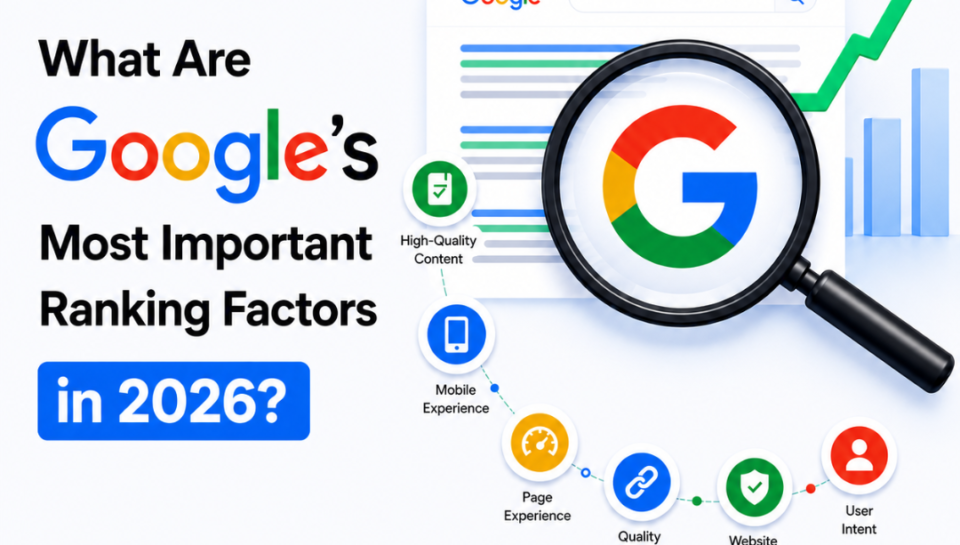
What Are Google’s Most Important Ranking Factors in 2026?
What Are Google’s Most Important Ranking Factors in 2026?
Google Ranking Factors in 2026 are primarily based on how well websites satisfy search intent, demonstrate real expertise, and deliver a high-quality user experience. Instead of relying heavily on keywords alone, Google’s algorithm now prioritizes content that reflects strong E-E-A-T (Experience, Expertise, Authoritativeness, and Trustworthiness), builds topical authority, and provides clear, helpful answers to user queries.
Technical performance, page experience, and user engagement signals also play a major role in determining rankings, especially with the rise of AI Overviews and generative search results. Websites that combine relevance, credibility, and usability are the ones most likely to consistently rank at the top.
1. Content Quality & Search Intent
Content remains the foundation of SEO, but in 2026, its definition has evolved significantly.
Google now evaluates:
- Whether content satisfies user intent (informational, transactional, navigational)
- Depth and originality of insights
- Real expertise and practical usefulness
- Content freshness and topical authority
Search intent alignment is now more important than keyword density. Pages that fail to answer user queries fully are unlikely to rank, even if they are well-optimized.
Key Insight: Google rewards “helpful content ecosystems,” not isolated articles.
2. E-E-A-T (Experience, Expertise, Authoritativeness, Trustworthiness)
E-E-A-T is one of the most critical SEO ranking factors in 2026.
Google evaluates:
- Experience: Has the author actually used or experienced the topic?
- Expertise: Does the content demonstrate deep subject knowledge?
- Authoritativeness: Is the website recognized in its niche?
- Trustworthiness: Is the information accurate and verifiable?
In 2026, Google heavily relies on entity-based understanding and author credibility signals. Websites with verified authors, strong brand reputation, and consistent publishing history perform significantly better.
Key Insight: E-E-A-T is not just a ranking signal but a credibility framework – websites that clearly demonstrate real-world experience, subject expertise, and strong brand trust consistently outperform generic, AI-like content.
3. Core Web Vitals & Page Experience
Page experience remains a core algorithmic signal in 2026.
Key Metrics:
- LCP (Largest Contentful Paint): Loading performance
- INP (Interaction to Next Paint): Responsiveness
- CLS (Cumulative Layout Shift): Visual stability
Google prioritizes fast, stable, and responsive websites, especially on mobile devices. Slow-loading pages are increasingly filtered out of top results, even if the content is strong.
Key Insight: Page experience is a direct ranking differentiator – websites that load quickly, respond instantly, and maintain visual stability consistently outperform slower sites, even when content quality is similar.
4. Backlinks & Authority Signals
Backlinks are still powerful, but their role has matured.
What matters in 2026:
- Relevance over volume
- Contextual backlinks from authoritative sources
- Natural link acquisition patterns
- Brand mentions without links (co-citations)
Google’s AI now evaluates link authenticity more effectively, reducing the impact of spammy or paid link schemes.
Key Insight: Backlinks act more as trust signals than ranking shortcuts—Google prioritizes relevant, naturally earned links and authoritative mentions over high-volume or artificially built link profiles.
5. On-Page SEO Optimization
On-page SEO continues to be essential but must align with semantic search principles.
Key elements include:
- Optimized title tags and meta descriptions
- Structured headings (H1, H2, H3)
- Internal linking for topic clusters
- Semantic keyword usage instead of repetition
Modern SEO is less about exact-match keywords and more about topical depth and relevance.
Key Insight: In 2026, On-page SEO is driven by semantic relevance and topic depth – pages that are well-structured, internally linked, and contextually rich consistently outperform those relying on exact-match keyword optimization.
6. User Engagement Signals
Google increasingly uses behavioral signals to measure content satisfaction.
Important metrics include:
- Dwell time (how long users stay)
- Bounce rate patterns
- Click-through rate (CTR)
- Scroll depth and interaction levels
If users consistently engage with your content, Google interprets it as a strong relevance signal.
Key Insight: User engagement signals act as a real-time quality check – content that keeps users engaged through longer dwell time, meaningful interactions, and strong click behavior is consistently rewarded with higher visibility in search results.
7. AI & Search Behavior Changes
Search in 2026 is heavily influenced by AI systems.
Key developments:
- AI-generated overviews in SERPs
- Conversational search queries
- Voice search optimization
- Context-aware recommendations
This means content must be structured for both humans and AI systems that summarize and reinterpret information.
Key Insight: SEO success depends on how well content is understood and reused by AI systems – well-structured, context-rich pages are more likely to be featured in AI-generated overviews, conversational answers, and voice search results.
8. Technical SEO Factors
Technical SEO remains the foundation of crawlability and indexing.
Key factors:
- Clean site architecture
- Proper XML sitemaps
- Structured data (Schema markup)
- Secure HTTPS protocol
- Efficient crawl budget usage
Without strong technical SEO, even high-quality content may not get indexed properly.
Key Insight: Technical SEO is the foundation of visibility – websites with clean architecture, structured data, and efficient crawlability ensure their content is properly indexed and eligible to rank, regardless of quality.
9. Mobile Optimization & UX
Google is fully mobile-first in 2026.
A strong mobile experience includes:
- Responsive design across all devices
- Fast-loading mobile pages
- Simplified navigation
- Accessible UI/UX design
User experience is now directly tied to ranking performance.
Key Insight: Mobile-first UX is a direct ranking factor. Websites that deliver fast, responsive, and easy-to-navigate mobile experiences consistently outperform those with poor mobile usability, even if their content is strong.
10. Brand Signals
Brand authority is becoming a major differentiator in search rankings.
Google evaluates:
- Branded search volume
- Social media mentions
- Online reviews and reputation
- Entity recognition across the web
Strong brands are more likely to rank because they demonstrate trust and recognition.
Key Insight: Brand signals act as a trust multiplier – websites with strong recognition, consistent online mentions, and positive reputation are more likely to rank higher because Google associates brand authority with credibility and user trust.
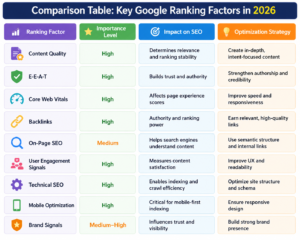
Comparison Table: Key Google Ranking Factors in 2026
Common SEO Mistakes in 2026
Many websites still fail due to outdated SEO practices:
- Keyword stuffing instead of semantic optimization
- Ignoring user intent and search behavior
- Weak or poorly structured content
- Poor mobile usability and slow pages
- Relying on low-quality or spammy backlinks
Avoiding these mistakes is essential for sustainable rankings.
For example, a website that repeatedly uses the exact keyword “best digital marketing agency” in every sentence without answering user intent often ends up ranking lower than a competitor that provides a well-structured, helpful guide covering services, case studies, and user-focused insights.
Future of Google Ranking Factors
The future of SEO is increasingly AI-driven.
Key trends include:
- Fully AI-powered ranking systems
- Hyper-personalized search results
- Stronger emphasis on trust and real-world authority
- Entity-based SEO replacing traditional keyword SEO
- Integration of multimodal search (text, voice, visual)
In short, SEO is evolving from optimization to understanding user intent at scale.
Conclusion
The landscape of Google ranking factors in 2026 reflects a major shift toward quality, trust, and user satisfaction. Ranking today is no longer about optimizing isolated elements -it requires a holistic strategy combining content excellence, technical performance, authority building, and user experience.
Businesses that succeed in SEO today are those that focus on long-term value creation rather than short-term ranking tricks. Understanding how Google ranks websites in 2026 is the key to building sustainable organic growth.
Looking to improve your Google rankings in 2026?
Partner with BrainyDX to build future-ready SEO strategies that go beyond rankings and focus on real business growth. From advanced content optimization to technical SEO and authority building, we help you maximize visibility, attract high-intent traffic, and convert visitors into customers.
Start building sustainable organic growth today with a strategy designed for the future of search.