
Is Zero-Click Search Killing SEO?
Is Zero-Click Search Killing SEO?
Search engine optimization has never stood still. From Google’s Panda and Penguin updates to mobile-first indexing and Core Web Vitals, SEO has constantly evolved alongside changing search behavior.
Now, another major shift is transforming how users interact with search engines: Zero-Click Search.
With Google AI Overviews, Featured Snippets, knowledge panels, and AI-powered search experiences becoming more common, many business owners are asking one important question:
Is Zero-Click Search Killing SEO?
The short answer is no.
SEO is not dying – it is evolving. While zero-click search is changing how users consume information and reducing clicks for some types of searches, it also creates new opportunities for brands that understand modern search behavior.
Let’s explore why.
What Is Zero-Click Search?
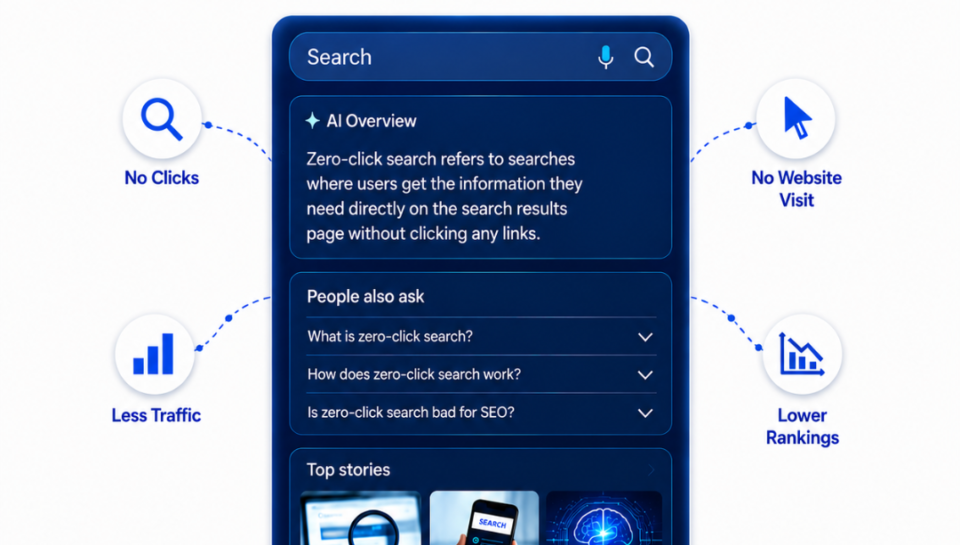
Zero-Click Search refers to search results where users find the information they need directly on the search results page without visiting any website.
Instead of clicking a webpage, Google displays answers through:
- Featured Snippets
- Google AI Overviews
- Knowledge Panels
- People Also Ask
- Local Packs
- Instant Answers
- Weather, calculations, sports scores, and more
For example, if someone searches:
“What is Zero-Click Search?”
Google may instantly provide the definition at the top of the page.
The user gets the answer without clicking a website.
This is why it’s called a Zero-Click Search.
Why Is Zero-Click Search Growing?
Search engines are focused on improving user experience.
Today’s users expect answers immediately.
Instead of making users browse multiple websites, Google now provides summarized information directly within search results.
The rise of Google AI Overviews has accelerated this trend even further.
AI now combines information from multiple trusted sources to create quick summaries for users.
Similarly, AI-powered search engines provide conversational answers rather than just lists of blue links.
This means users spend more time on the search results page and less time visiting websites for simple informational queries.
Does Zero-Click Search Reduce Organic Traffic?
Yes, but only for certain types of search queries. Informational searches are the most affected, including queries such as “What is SEO?”, weather updates, currency conversions, the age of public figures, and simple definitions. In the past, users typically clicked on websites to find these answers.
Today, Google often displays the information directly within search results through features like AI Overviews, featured snippets, and knowledge panels. As a result, many websites are experiencing lower click-through rates (CTR) even when they continue to rank highly in search results.
However, this does not mean that all organic traffic is disappearing. Instead, the impact varies depending on the type of search intent, with informational queries seeing the greatest decline while commercial, transactional, and in-depth informational searches continue to generate valuable website visits.
Commercial, transactional, and high-intent searches still generate significant website visits because users need more information before making decisions.
For example:
- Best CRM software
- SEO agency in India
- Digital marketing pricing
- Compare accounting software
Users still click websites to evaluate options.
Why SEO Is Evolving Rather Than Dying
One of the biggest misconceptions surrounding zero-click search is that fewer website clicks mean SEO is becoming obsolete. In reality, SEO has always evolved alongside Google’s algorithm updates and changing search behavior. The focus has shifted from simply securing the top ranking to becoming a trusted and authoritative source that search engines and AI-powered platforms choose to reference.
Modern SEO emphasizes building topical authority, answering user questions comprehensively, demonstrating expertise, creating trustworthy content, and optimizing for AI-driven search experiences.
Businesses that adapt to these evolving practices can continue to achieve strong online visibility, attract qualified audiences, and build long-term organic growth. In fact, AI-powered search often favors websites that consistently publish high-quality, well-structured, and authoritative content, making content quality and credibility more important than ever.
How Google AI Overviews Are Changing SEO
Google AI Overviews summarize information from multiple high-quality sources before presenting an answer.
Instead of displaying only one Featured Snippet, AI may reference several websites.
This creates a new opportunity.
Rather than competing only for Position One, websites can compete to become trusted AI citation sources.
Businesses that produce expert-level content are more likely to appear in AI-generated summaries.
This makes quality more important than ever.
Winning SEO Strategies in the Age of AI Search
Create High-Quality Content
AI-powered search systems prioritize content that is useful, original, accurate, and trustworthy. Rather than publishing large volumes of generic content, businesses should focus on creating comprehensive, high-quality articles that genuinely help users solve problems and make informed decisions.
Content should answer user questions clearly, include practical examples, provide expert insights, and offer unique perspectives that add value beyond what is already available online.
By consistently producing well-researched and user-focused content, businesses can build authority, improve their visibility in AI-driven search results, and earn long-term organic traffic. In today’s search landscape, quality consistently outperforms quantity.
Build Topical Authority
Publishing a single article on a topic is no longer enough to establish authority in search results. Modern search engines and AI-powered platforms favor websites that demonstrate comprehensive expertise across an entire subject area.
For example, if your business offers SEO services, your content strategy should cover a wide range of related topics, including Technical SEO, Local SEO, AI Search, Content Marketing, Keyword Research, Schema Markup, Google Search Console, and Link Building.
Creating a well-connected ecosystem of in-depth, high-quality content helps establish topical authority, strengthens your website’s credibility, and increases its ability to rank for a broader range of relevant search queries over time.
Match Search Intent
Understanding search intent has become one of the most important factors in modern SEO. Every search query reflects a specific user goal, whether it is to gather information, compare options, explore solutions, or make a purchase.
Creating content that aligns with the intent behind each keyword ensures that users find the answers they are looking for quickly and effectively.
When content meets user expectations, it encourages higher engagement, improves the overall user experience, and increases the likelihood of ranking well in both traditional search results and AI-powered search platforms.
Optimize for Featured Snippets
Featured Snippets continue to play an important role in improving search visibility and establishing brand credibility. To increase the likelihood of earning a Featured Snippet, content should answer user questions directly, provide clear and concise explanations, include well-structured numbered or bulleted lists where appropriate, define key concepts clearly, and use logical headings to organize information.
Although users may not always click through to the website, appearing in a Featured Snippet enhances brand awareness, reinforces authority, and positions your business as a trusted source of information.
Implement Schema Markup
Schema Markup helps search engines better understand the context and structure of your content, making it easier to present relevant information to users. By adding structured data to your website, you can improve your eligibility for enhanced search features such as Rich Results, FAQs, Product Listings, Review snippets, and AI-powered search experiences.
Depending on the type of content you publish, implementing Schema types such as FAQ, Article, Organization, Product, and Breadcrumb can provide valuable context to search engines.
While Schema Markup does not directly improve search rankings, it enhances your content’s visibility, increases the likelihood of rich search appearances, and helps search engines interpret your website more accurately.
Follow Google’s E-E-A-T Guidelines
Google increasingly evaluates content based on E-E-A-T (Experience, Expertise, Authoritativeness, and Trustworthiness) to determine its credibility and value for users.
Businesses can strengthen these signals by demonstrating real-world experience, showcasing author credentials, citing reliable sources where appropriate, regularly updating content to maintain accuracy, and providing transparent business information.
Building strong E-E-A-T not only enhances user trust but also helps traditional search engines and AI-powered search systems identify your website as a reliable and authoritative source of information, improving your long-term search visibility.
Should Businesses Still Invest in SEO?
Absolutely.
Absolutely. SEO remains one of the highest-return digital marketing strategies for generating sustainable, long-term organic growth. Unlike paid advertising, which stops driving traffic once the budget is exhausted, SEO continues to deliver visibility, qualified traffic, and potential leads over time.
However, succeeding in today’s search landscape requires a more comprehensive approach than traditional keyword optimization alone. Businesses should combine high-quality content marketing, technical SEO, exceptional user experience, structured data, brand authority, and AI optimization to meet the evolving expectations of search engines and users.
Companies that invest in these areas will be better positioned to maintain strong search visibility, adapt to AI-driven search experiences, and remain competitive as search continues to evolve.
The Future of SEO in an AI-Driven World
Search engines are becoming answer engines.
Instead of simply indexing webpages, they interpret, summarize, and recommend trusted information.
This means brands must think beyond rankings.
Future SEO success will depend on:
- Becoming an authoritative source
- Publishing original research
- Building audience trust
- Creating expert-led content
- Maintaining technical excellence
- Updating content regularly
Rather than asking, “How do I rank first?” businesses should ask, “How do I become the most trusted answer?”
That mindset will shape successful SEO strategies in the years ahead.
Conclusion
So, Is Zero-Click Search Killing SEO?
The evidence suggests otherwise. While Zero-Click Search, Google AI Overviews, and AI Search are changing how users discover information and may reduce Organic Traffic for simple informational queries, they are not making SEO obsolete. Instead, they are raising the standard for what ranks and what gets referenced.
Businesses that focus on creating valuable content, understanding Search Intent, building topical authority, implementing Schema Markup, optimizing for Featured Snippets, and following Google’s E-E-A-T principles will be better positioned to earn visibility in both traditional and AI-powered search results.
The future belongs to brands that adapt rather than resist change. If you want to maintain long-term organic visibility, now is the time to evolve your SEO Strategy for the AI era. Start investing in high-quality, user-focused content today, and you’ll be well-equipped to thrive in the next generation of search.