How Can Custom Software Improve Business Efficiency?

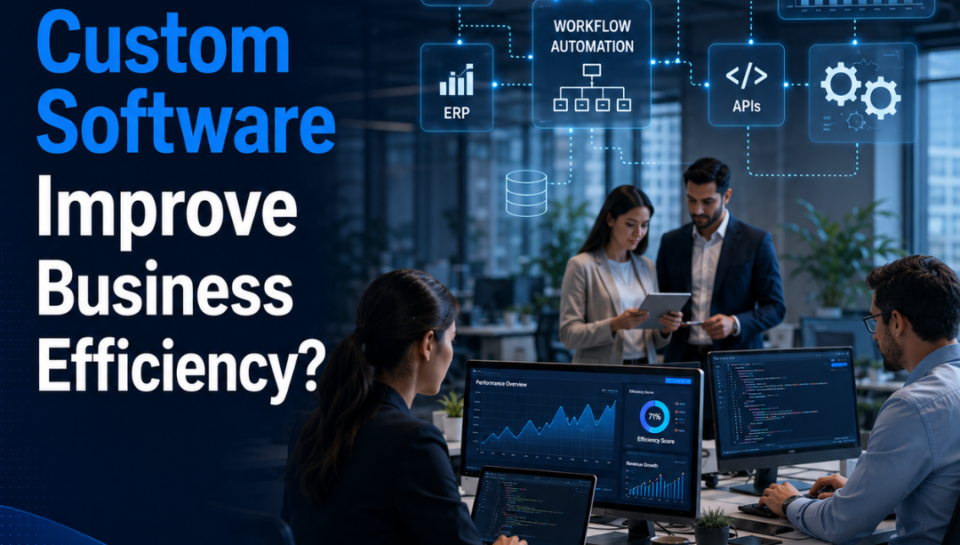
How Can Custom Software Improve Business Efficiency?
In today’s competitive business environment, efficiency is no longer just an advantage – it is a necessity. Organizations are under constant pressure to reduce operational costs, improve productivity, and deliver better customer experiences. While off-the-shelf software can meet basic requirements, it often falls short when businesses have unique workflows or industry-specific needs.
This is where Custom Software Development becomes a strategic investment. But How Can Custom Software Improve Business Efficiency? By creating software tailored to your business processes, organizations can automate repetitive tasks, eliminate bottlenecks, improve collaboration, and support long-term growth.
Whether you’re a startup, SME, or enterprise, custom software can transform the way your business operates while improving Business Efficiency, Operational Efficiency, and overall performance.
What Is Custom Software?
Custom software is a software application specifically designed and developed to meet the unique requirements of a business or organization. Unlike generic software products that serve a broad audience, Custom Software Solutions are built around your workflows, goals, and operational challenges.
Examples include:
- Customer Relationship Management (CRM) systems
- Enterprise Resource Planning (ERP) software
- Inventory Management Systems
- Employee Management Platforms
- Healthcare Management Software
- Manufacturing Automation Systems
- Financial Management Applications
Because these solutions are designed specifically for your business, they integrate seamlessly with existing systems and provide greater flexibility than standard software.
The Business Impact of Custom Software
The biggest advantage of custom software is that it supports the way your business actually works instead of forcing your team to adapt to generic software limitations.
1. Automates Repetitive Tasks
Repetitive manual tasks often consume valuable employee time, reduce productivity, and increase the likelihood of human error. Custom software automates routine business processes such as data entry, invoice generation, report creation, employee attendance tracking, customer follow-ups, and approval workflows. By streamlining these everyday operations, businesses can improve accuracy, accelerate process completion, and allow employees to focus on high-value, strategic initiatives that drive growth and innovation.
2. Streamlines Business Processes
Many businesses rely on multiple disconnected applications, leading to duplicate work and communication gaps.
Custom software centralizes operations by connecting departments, creating smoother workflows, and enabling Business Process Automation across the organization. Teams spend less time switching between systems and more time delivering results.
3. Increases Productivity
Employees work more efficiently when software is built around their daily tasks.
Instead of navigating unnecessary features found in generic applications, users have access only to the tools they need. This reduces training time, improves user adoption, and increases overall productivity.
4. Improves Data Accuracy
Data inconsistencies often occur when employees manually transfer information between systems.
Custom software eliminates duplicate data entry by integrating multiple business applications into a single platform. Real-time synchronization reduces errors and ensures decision-makers always have accurate information.
5. Supports Better Decision-Making
Modern businesses rely on data to make informed decisions.
Custom software can include:
- Real-time dashboards
- Performance analytics
- KPI tracking
- Automated reports
- Predictive insights
Business leaders gain immediate visibility into operations, helping them identify opportunities and resolve issues faster.
6. Enhances Customer Experience
Modern customers expect fast responses, personalized interactions, and a seamless service experience across every touchpoint. Custom software helps businesses meet these expectations by centralizing customer information, streamlining support requests, personalizing communications, automating notifications, and improving overall service delivery.
With better access to customer insights and more efficient processes, businesses can respond more quickly, build stronger relationships, enhance customer satisfaction, and increase long-term customer retention.
7. Scales with Business Growth
As businesses grow, operational requirements become more complex.
Unlike many off-the-shelf solutions, custom software is built with scalability in mind. New modules, integrations, and features can be added without replacing the entire system.
This makes custom software a long-term investment rather than a temporary solution.
8. Strengthens Security
Protecting sensitive business data has become a critical priority for organizations of all sizes. Since off-the-shelf software is widely used, it is often a more common target for cyberattacks. Custom software enables businesses to implement security measures tailored to their specific operational and compliance requirements.
Features such as role-based access control, multi-factor authentication (MFA), data encryption, secure API integrations, and compliance-focused architecture help strengthen data security and reduce potential vulnerabilities.
By incorporating these safeguards from the outset, businesses can better protect confidential information, minimize security risks, and maintain customer trust.
Industries That Benefit from Custom Software
Custom software delivers measurable benefits across a wide range of industries by addressing unique operational challenges and improving business efficiency. Unlike off-the-shelf solutions, it is designed to support industry-specific workflows, automate critical processes, and enhance productivity.
- Healthcare: Simplifies patient management through electronic medical records (EMRs), appointment scheduling, billing automation, and secure patient data management, enabling healthcare providers to deliver faster and more accurate care.
- Manufacturing: Improves operational efficiency with production planning, inventory tracking, supply chain management, and quality control systems that help reduce downtime and optimize resource utilization.
- Retail & E-commerce: Streamlines inventory management, order processing, customer loyalty programs, and sales analytics, helping businesses enhance customer experiences and make data-driven decisions.
- Finance: Supports accurate financial reporting, expense management, compliance monitoring, and risk assessment while ensuring greater transparency and regulatory compliance.
- Logistics & Transportation: Optimizes fleet management, route planning, warehouse operations, and shipment tracking to reduce operational costs and improve delivery efficiency.
- Education: Enhances learning and administrative processes through learning management systems (LMS), student portals, online assessments, attendance tracking, and administrative automation, creating a more efficient educational environment.
Signs Your Business Needs Custom Software
As businesses grow, their operational requirements become more complex, and generic software solutions may no longer be sufficient. If your team spends excessive time on manual tasks, relies heavily on spreadsheets, or struggles with disconnected systems that create inefficiencies, it may be time to consider custom software.
Other common signs include existing software lacking essential features, slow customer service caused by outdated systems, manual report generation, and difficulty integrating multiple business applications.
Another strong indicator is when your business outgrows its current software. As operations expand, scalable and tailored solutions become essential for maintaining productivity, improving collaboration, and supporting future growth. If your organization faces several of these challenges, investing in professional Software Development Services can help streamline operations, automate workflows, and improve overall business efficiency.
How to Choose the Right Custom Software Development Partner
Choosing the right software development company is just as important as choosing to build custom software.
Look for a partner that offers:
Industry Experience
Choose a company with experience developing software for businesses similar to yours.
Strong Technical Expertise
Ensure they specialize in modern technologies, cloud platforms, APIs, cybersecurity, and scalable architecture.
Transparent Development Process
A reliable development partner should provide:
- Requirement analysis
- UI/UX design
- Agile development
- Regular progress updates
- Quality assurance testing
- Ongoing maintenance and support
Scalability
Your software should be designed to grow alongside your business without requiring major redevelopment.
Post-Launch Support
Software requires continuous improvements, updates, and security patches. Long-term support ensures your investment continues delivering value.
Investing in the Right Solution
Custom Software enables businesses to automate repetitive tasks, streamline workflows, improve collaboration, strengthen security, enhance customer experiences, and make better decisions using real-time data.
Unlike one-size-fits-all software, Custom Software Development creates solutions tailored to your organization’s unique requirements, making operations faster, more efficient, and easier to scale. Whether you’re a startup looking to establish efficient processes or an enterprise pursuing Digital Transformation, investing in Custom Software Solutions can deliver lasting operational and competitive advantages.
Partnering with the right Software Development Services ensure that your software aligns with your business goals today while remaining flexible enough to support long-term growth.
BrainyDX designs scalable, secure, and tailored software solutions that streamline operations, automate workflows, and support long-term growth. Contact our experts today to discuss your project.