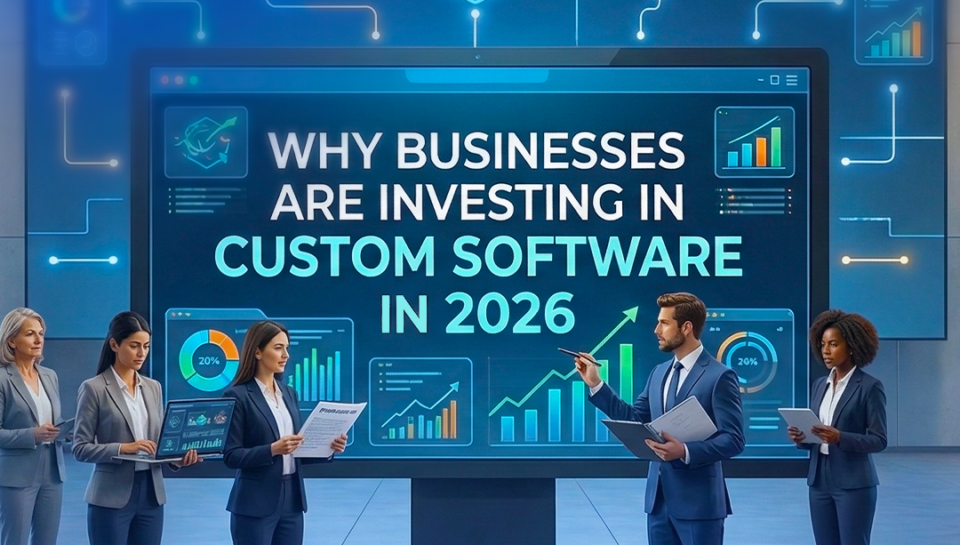
Why Businesses Are Investing in Custom Software in 2026

Why Businesses Are Investing in Custom Software in 2026

Businesses are investing heavily in custom software in 2026 because it offers better scalability, data control, and workflow flexibility compared to generic tools. Instead of asking whether they need digital transformation, companies are now asking how fast they can implement it. Off-the-shelf tools once seemed convenient, but today’s competitive environment demands precision, scalability, and adaptability. That is why custom software development has become a strategic investment rather than just a technical expense.
From startups to large enterprises, organizations are realizing that tailor-made digital solutions offer long-term value, operational efficiency, and stronger competitive positioning. When software is designed around a company’s workflow, it removes friction from daily operations and allows teams to focus on growth instead of system limitations.
As industries become more data-driven and digitally connected, businesses want tools that evolve with them. Custom software gives them that flexibility. Instead of adjusting their operations to fit predefined systems, they can build platforms that align perfectly with how their business actually functions.
Let’s explore why custom software is becoming the backbone of modern business growth in 2026.
Are Businesses Tired of Adjusting Their Processes?
Businesses are increasingly tired of adjusting their processes just to match the limitations of generic software platforms. Over time, companies carefully build workflows that suit their team structure, customer journey, and operational goals. These processes are not random; they are the result of years of experimentation, improvement, and real-world experience.
However, when businesses adopt off-the-shelf software solutions, they often find themselves forced to modify these carefully designed workflows. Teams often adapt their operations just to fit the system’s predefined structure.
This leads to several inefficiencies.
For example, employees may start maintaining separate spreadsheets to track information that the software cannot manage properly. Some departments may rely on manual notes or duplicate data entry because the system does not fully support their workflow. Over time, these small workarounds accumulate and create operational friction across the organization.
At first, these adjustments may seem manageable. But as the business grows, these inefficiencies become more visible. Departments struggle to stay aligned, communication gaps appear, and productivity begins to decline.
Custom software development addresses this problem by reversing the approach. Instead of forcing teams to adapt to rigid systems, the software is designed around the company’s natural way of working. This alignment improves clarity, reduces manual tasks, and allows employees to operate more efficiently.
When tools support the workflow rather than restrict it, teams perform better and organizations can move faster.
Does the Wrong Technology Make Business Scaling Risky?
Growth is exciting for any business, but it also exposes weaknesses in technology infrastructure. A system that works perfectly for a small team may struggle once the company expands.
For example, a platform designed for a few hundred users might not perform well when the user base grows to several thousand. Similarly, dashboards that once seemed simple can become cluttered when multiple departments rely on them for different purposes. Integrations between tools may become difficult to manage as the company adopts new platforms for marketing, sales, customer service, and operations.
In 2026, businesses are scaling faster than ever through digital channels. Online marketing campaigns, automated workflows, and global customer bases mean that companies must handle larger volumes of data and activity. If the underlying software infrastructure is fragile, growth can quickly turn into a technical challenge.
Custom software development helps businesses prepare for growth from the beginning. Instead of relying on systems that may struggle under pressure, companies can design platforms with scalability in mind. Developers can build flexible architectures that support expansion without requiring constant system replacements.
This approach reduces the likelihood of sudden platform migrations or operational disruptions. Businesses gain confidence knowing their systems can grow alongside their operations.
For many leaders, investing in scalable technology is not just about improving performance today. It is about ensuring stability and reliability as the company grows in the future.
Is Data Ownership Becoming a Bigger Conversation?
Yes, data ownership has become one of the most important strategic conversations for modern businesses. In the past, many companies did not question where their data was stored or how external platforms handled it. Today, that mindset is changing rapidly.
Business leaders now ask critical questions about their digital infrastructure. Who has access to our data? Where is it hosted? What happens if a third-party platform changes its policies, pricing structure, or security standards?
These questions reflect a broader shift in how organizations view their digital assets. Data is no longer just operational information. It has become one of the most valuable resources a company owns.
When businesses rely heavily on third-party software platforms, they often share control over that data. While these tools provide convenience, they may limit flexibility in terms of data access, integration capabilities, and security management.
Custom-built systems allow companies to regain control over their digital environment. Organizations can define how information moves within their systems, establish security protocols tailored to their needs, and set precise access permissions for employees and partners.
This level of control is particularly important for industries that handle sensitive or regulated data, such as finance, healthcare, logistics, or e-commerce.
For many business leaders, investing in custom software development is not only about improving operational efficiency. It is also about protecting and managing the data that drives their decision-making and long-term growth.
Are Businesses Thinking Long Term Instead of Short-Term Software Costs?
Another major reason businesses are investing in custom software is the shift toward long-term financial planning. Subscription-based software once appeared highly affordable because of its low upfront cost. However, the long-term expenses associated with these tools can grow significantly over time.
Monthly or annual subscription fees may increase as businesses add more users, require additional features, or integrate multiple platforms. What initially seemed like a simple cost can gradually become a significant financial commitment.
Business leaders in 2026 are taking a more strategic approach to these decisions. Instead of asking which solution is cheapest today, they are asking which option makes the most sense over the next five or ten years.
Custom software development often requires a larger initial investment, but it removes dependency on recurring licensing models. Once the system is built, businesses have full ownership and can expand or modify the platform as their needs evolve.
This independence allows companies to innovate faster. They can add new features, improve workflows, and integrate new technologies without waiting for external software providers to release updates.
In the long run, many organizations find that custom software provides greater flexibility and financial control compared to relying solely on subscription-based platforms.
Ready to Build Software That Truly Fits Your Business?
As digital transformation continues to accelerate, businesses are realizing that the tools they use can either support their growth or slow it down. Generic software may work for basic operations, but companies with unique processes and ambitious goals often require more tailored solutions.
Custom software development allows organizations to build platforms that match their workflows, scale with their growth, and give them full control over their data and technology infrastructure.
If you are considering moving beyond generic tools and creating systems designed specifically for your operations, BrainyDX can guide you through the process.
At BrainyDX, we begin by understanding how your business truly functions. We analyze your challenges, your operational workflows, and your long-term growth plans. From there, we design digital solutions that are practical, scalable, and aligned with your strategic goals.
Custom software should feel like an investment in clarity and control, not complexity. With the right development partner, businesses can build technology that empowers their teams, improves efficiency, and supports sustainable growth.
Let’s build software that works the way your business works.