
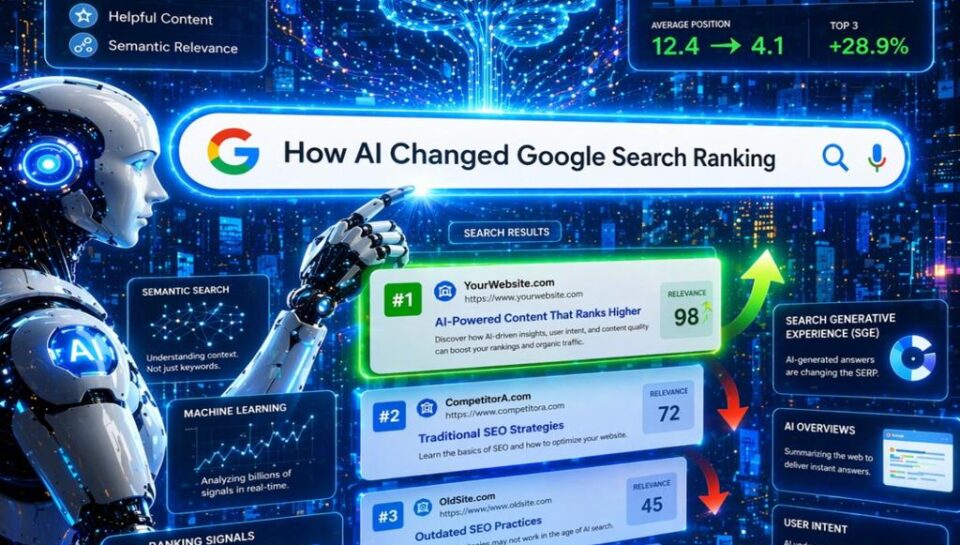
How AI Changed Google Search Ranking
How AI Changed Google Search Ranking
A few years ago, ranking on Google meant optimizing keywords and building backlinks.
Today, your content might not even get clicked because AI answers the query before users reach your website. From RankBrain to BERT, MUM, and now AI Overviews, Google’s ranking systems now prioritize meaning over keywords and helpfulness over manipulation.
For business owners, marketers, SaaS brands, and SEO professionals, this shift has completely changed how visibility works.
In this new era, traditional SEO still matters, but AI SEO, GEO, and answer engine optimization now define who gets discovered.
Google now ranks answers, not just pages.
This shift means two pages targeting the same keyword can perform very differently based on how completely they satisfy user intent.
Earlier, SEO was heavily dependent on:
- Exact-match keywords
- Backlinks
- Metadata optimization
- Keyword density
Now Google uses AI systems like:
- RankBrain → query understanding and satisfaction signals
- BERT → natural language comprehension
- MUM → multimodal understanding
- AI Overviews → direct answer generation at the top of SERPs
These systems don’t just analyze words, they evaluate user satisfaction signals like dwell time, query refinement, and content completeness.
This means pages must be clear, contextual, and trustworthy enough to be cited by AI systems.
Semantic Search and Search Intent Matter More Than Keywords
AI has made semantic SEO the foundation of ranking.
Google no longer relies only on the exact phrase “how AI changed Google search ranking.”
It now understands related intent like:
- Impact of AI on SEO
- Future of Google ranking
- How AI affects SERPs
- AI search optimization strategies
This is why keyword stuffing no longer works.
For example, a blog targeting “website development company” will rank better if it also naturally includes:
- Pricing models
- Tech stacks
- Hiring process
- Comparisons with freelancers
- Case studies
Instead, Google evaluates:
- Topic depth
- Related subtopics
- Intent satisfaction
- Entity relationships
- Contextual relevance
Real Example
A SaaS brand writing about CRM software should cover:
- Best CRM use cases
- Implementation cost
- Integrations
- Alternatives
- Comparisons
- Enterprise workflows
This creates semantic authority.
EEAT is now a ranking filter, not just a guideline
AI systems are designed to reduce misinformation.
That is why EEAT (Experience, Expertise, Authoritativeness, Trustworthiness) now directly influences AI search visibility.
Google’s AI systems prefer sources with:
- Expert-written insights
- Suthor bios
- Original examples
- Research-backed claims
- Strong brand mentions
- Credible citations
Topical authority now beats isolated blog posts.
Winning Strategy
Instead of writing 20 random SEO blogs, create one topic cluster around:
- AI SEO
- GEO
- answer engine optimization
- AI Overviews
- conversational search
- AI content visibility
This improves Google ranking factors and AI citations.
AI Overviews, Zero-Click Search, and Lost Organic Clicks
The rise of AI Overviews has changed SERP behavior dramatically.
Google now summarizes answers directly in search results, leading to zero-click searches, where users get answers without visiting websites. Recent industry studies show AI Overviews now appear in a significant share of informational searches and can reduce CTRs for traditional blue links. In some cases, early studies suggest CTR drops of 20–40% for informational queries where AI summaries dominate the top of the page.
What This Means for Businesses
Your goal is no longer only:
Rank #1 on Google
Now it is:
Become the source Google’s AI cites
This is where GEO (Generative Engine Optimization) becomes essential.
Featured Snippets and Conversational Search Are Evolving
AI is replacing classic snippet behavior with conversation-style answers.
Instead of optimizing only for featured snippets, content must now support:
- Follow-up questions
- Natural language phrasing
- Voice search
- Long-tail conversational queries
- Multi-step intent journeys
Example
Instead of:
Best CRM software
Users now ask:
What’s the best CRM for a growing SaaS company with enterprise sales teams?
Content that directly answers the question in the first 40–60 words has a much higher chance of being selected for AI summaries and voice responses.
AI ranking systems understand this layered intent.
That’s why comparison pages and decision-stage content perform exceptionally well.
Why Structured Data and Schema Matter More Than Ever
Schema helps AI understand your content faster.
Important schema types:
- FAQ Schema
- Article Schema
- Organization Schema
- Product Schema
- Review Schema
- How To Schema
For example, FAQ schema can increase the chances of your content appearing in AI-generated answers for question-based searches.
Structured data improves:
- Machine readability
- AI extraction
- Featured answer eligibility
- AI Overview citations
For AI SEO, schema is no longer optional.
It is a core ranking support layer.
How Businesses Should Adapt for ChatGPT and AI Search
Modern SEO must now work across:
- ChatGPT
- Gemini
- Perplexity
- AI answer engines
This is where answer engine optimization becomes the next evolution of SEO.
Best Practices
1) Create answer-first content
Give the direct answer in the first 80–100 words.
2) Build comparison pages
Examples:
- BrainyDX vs traditional SEO agencies
- Best GEO agency in India
- AI SEO tools comparison
3) Strengthen trust signals
Add:
- Case studies
- Reviews
- Expert authors
- Statistics
- Methodology
- Brand mentions
4) Use entity-based optimization
Make your brand strongly associated with:
- AI SEO
- GEO
- AI search optimization
- ChatGPT ranking
This improves AI search visibility.
The Future of SEO in the AI-First Era
The winners will be brands that combine:
- Semantic SEO
- Technical structure
- Entity authority
- Conversational UX
- EEAT
- GEO frameworks
- AI visibility tracking
The shift is clear:
The next evolution of SEO is not about ranking pages, but about becoming a trusted entity that AI systems consistently reference across platforms.
SEO + GEO + trust architecture = future-ready search dominance
One thing is clear – SEO is no longer a traffic game, it’s a visibility and trust game.
Final Thoughts
The brands winning today are not simply doing SEO.
They are building AI-first search ecosystems.
They create content that is:
- Citable
- Structured
- Trustworthy
- Conversational
- Comparison-ready
- Optimized for zero-click discovery
This is exactly the approach BrainyDX uses to help brands stay visible in AI-driven search environments.
Want your brand to stay visible in AI-powered search?
Brands that adapt early to AI-first search will dominate visibility in the next era of SEO.
Most businesses are still optimizing for old SEO.
The ones adapting to AI search today will dominate tomorrow.
Visibility in AI search is no longer optional, it’s a competitive advantage.
That’s exactly where BrainyDX is helping brands build AI-first visibility across Google, ChatGPT, and answer engines.